Lessons in participation and perceptions of the SSI doll project
by Aaron Pinsker and Norbert Pintsch
For the theorist, theory is a merciless work program. Success means having created the appropriate and plausible phrases after doing intensive work. It's a good feeling to live with, mobile and pecuniary!
The society, represented by its heads, leaders, agents, honors this and uses the phrases in good faith and for good things. The country needs keywords!
The representatives, leaders, agents of institutions and organizations need this help in order to become active in their fields.
Even if we don't like it, the reality is quite different and dramatic. The more theory there is, the more theory grows out of it - it is almost like fertilizer; however this fertilizer is of an artificial nature and it sticks more and more to the practical problems , commonly referred to as Practice!
Globalization makes the problem frightening! The theory, actually a tool to understanding the problem on a local and regional scale, is used unknowingly for standardization and that neglects the particularities of the region. It is rather understood to be universally and globally applicable. Why does'nt anybody tell me that?, so the call of a resident of old-people home suffering from dementia!
The seemingly problem solutions are always based on the usefulness. Usefulness is a result of political-social-economic* compulsions, with the additional issue that we lose our feet on the ground. Taking on these compulsions is a mammoth task, which is therefore not touched upon. That would involve too great corrective measures.
There is no reason to leave it at that, there are even solutions available, but they do not fit into the conventional grid; the main reason: the lack of pse * benefits!
Initiatives that benefit the general public are rare. If there are some, then they are politically, economically and religiously based and financed. This means that selflessness in initiatives is practically impossible. A popular question in such rare projects is: Who is funding this? - If the answer is lacking a reference to religion or politics, this unsettles the questioner. It cannot be what cannot be! The participants in such projects have shown that a) there is this attitude of selflessness and b) this unites strangers to the pse * and makes possible what actually does not work for the reasons mentioned.
A tedious job, far from theory, adapted to the local possibilities and the local, traditional culture, which represents the wealth of a region and works even better when the "foreign" participants bring their skills into the effort without appearing to be missionaries!
Labels: Aaron Pinsker, Berlin, Cultura e V, DGFK e V, FPAC Lahore, Nauen, Njini King Caro, Norbert Pintsch, Omar M Ali, Ricardo Coslez, SPARC-Project
posted by S A J Shirazi @ 9:42 AM,
,


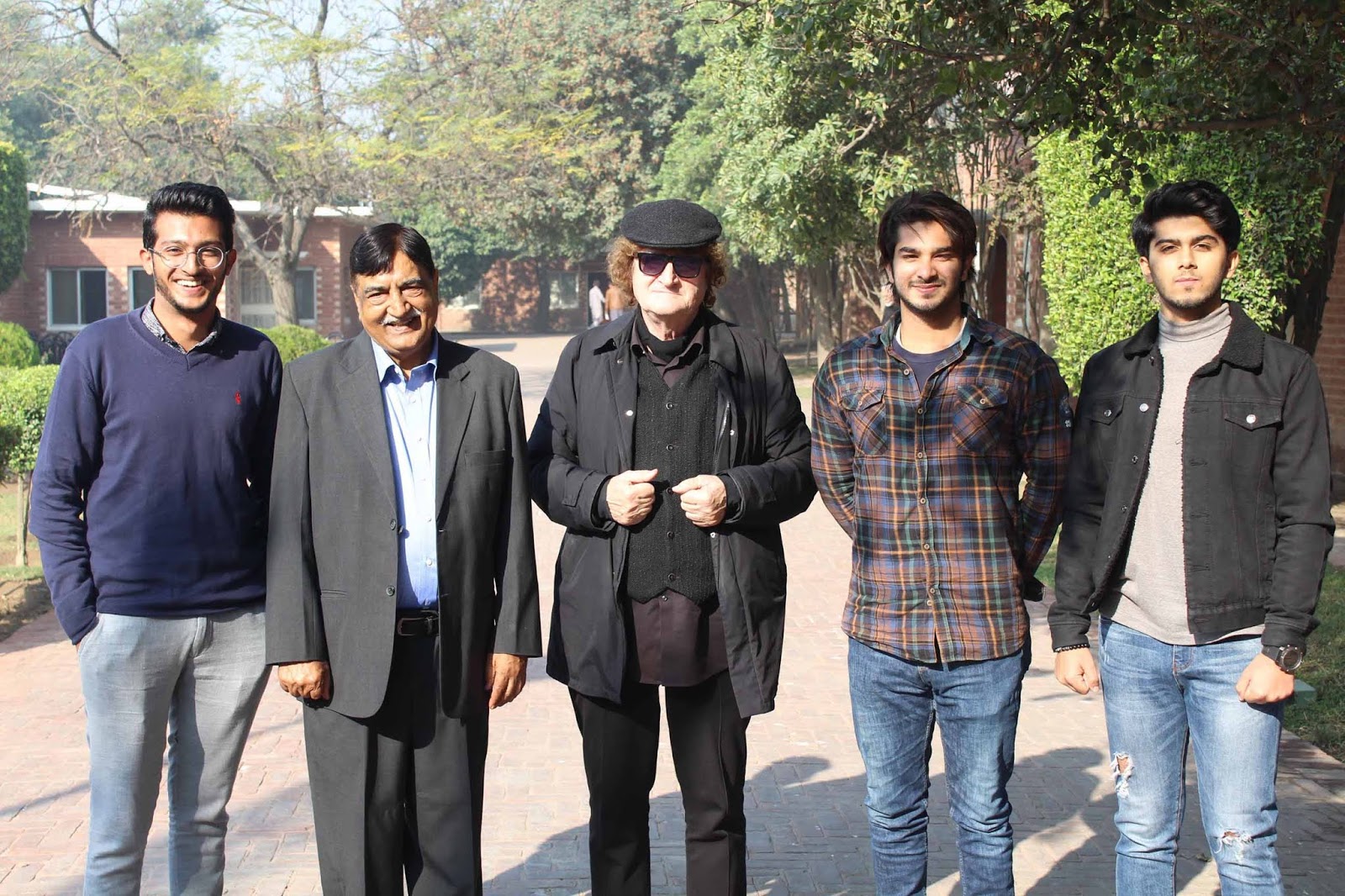
On the occasion of Prof Norbert Pintsch's visit to Pakistan, intensive talks were held about NGO projects, their functioning and the global difficulties, in view of which efforts were made to encourage private initiatives.
For some time, he and his colleagues have been using the long-standing material for evaluation and scientific workup; interested persons can find a wealth of material for independent and completely new research work in the internet under www.dgfk-archiv.de .
In addition to the contacts and visits to friends and acquaintances, visits were undertaken not only to the NGO AeFeA in the Okara district, but also to PU and LSE, as well as the IML in Lahore.
In a recently created slide show, the many activities for marketing of unique arts and crafts within and outside the country were outlined. They make clear, that NGO projects are not free from market-economy influences, if they are to be successful for all participants. The prerequisite here is however an altruistic attitude as a driving force!
Labels: fpac-greenmag, IML Lahore, LSE Lahore, Prof Dr Norbert Pintsch IPC FPAC, PU Lahore, SPARC-Project
posted by S A J Shirazi @ 3:53 PM,
,
What to do?
Wednesday, September 19, 2018
Discussion event during a
SPARC meeting in Lahore with Friends of the SSDC*** in TGD**.
While a lot is being said about freedom in a world of consumption, digitization and globalization, environmental protection and nature conservation in legal terms, but their implementation in an industrial environment is more than questionable.
Also, unselfishness and self-help may theoretically be mentioned, but practically it is not implemented.
The religion of wealth is not only believed in, but it is also practiced. Meanwhile, charitable models practically disappear in nothingness!
Self-involved and affected people in self-help projects behave as in the usual institutions and organizations, - regular income, leisure and progress are the criteria in urban life. This is in strong contrast to the goals of selfless-serving, philanthropy and self-help!
The impossibility of realizing this world-wide is not recognized at all, on the contrary, more and more resources are destroyed, preserved as values. The wealth of a country is based on industrial indicators. This affects the simple areas, including the rural area. Industry and mass production gain in importance.
Opportunities are not recognized or perceived and the orientation towards urban life and its prosperity psychosis grows.
New values and possible goals are ignored!
Projects that could give achieve such goals are not injected with man-power!
Wherever a cautious, sustainable development is possible, we close our eyes.
Modest touristic developments (guest houses, display of local history), cultural exchange (artists in residence, student visits from urban into rural), cooperation with other, similar NGOs, are not given importance. This is how the simple people in the rural areas help to cut down on the already little piece of economic independence they are sitting on.
What is need of the hour?
An unselfish, energetic person who sets a good example - who loves his traditional culture but thinks ahead of the ruling elites!
But in election this will not convert into votes ......
* Anjuman-e-Falah-e-Aama
** Thatta Ghulamka Dhiroka
*** Senta Siller Design Centre
Labels: DGFK, FBTC, FPAC, Norbert Pintsch, Senta Siller Design Centre, SPARC-Project, Thatta Kedona
posted by S A J Shirazi @ 3:23 PM,
,
by Omar M. Ali, Njini King Caro, Ricardo Coslez & Norbert Pintsch
Again and again, questions arise about what is special in SSI projects.
We have therefore made a list of characteristics for everyone interested,
although:
-the specialty should actually be logically self-evident:
-Local help with local resources
-Avoidance of migration, - to the urban areas or foreign countries
-Help should be holistic, so the problem solutions are not simply shifted to later time
-An NGO should never be a family clan, but open to all active members
-Help from the outside requires participation of concerned persons from the inside
-An NGO should always work with an open mind and be more flexible than government or private companies, etc.
-Local leadership should work as selfless as volunteers from outside
-An NGO is not a government organization or company; its products must stay below the BE point otherwise it will not be like a genuine NGO
-The head of the NGO must be on moral high ground; not enrichen himself , be communicative and possess broad experience!
Then why should not such head of the NGO work in a GO or Pvt Ltd company and earn better money?
Because ........ the benefit of the general public counts more!
Labels: DGFK, FBTC, FPAC, Njini King Caro, Norbert Pintsch, Omar M Ali, Ricardo Coslez, SPAETcolombis, SPARC-Project, SPATHcameroon
posted by S A J Shirazi @ 1:25 PM,
,
Prof Dr Norbert Pintsch talked to Professor Doctor Rubeena, Institute for Social and Cultural
Affairs / Punjab University Lahore on further lectures
concerning Housing and so on
Labels: Prof Dr Norbert Pintsch Senior Research Fellow/FPAC, Prof Dr Rubeena Ashraf, Punjab University, SPARC-Project
posted by S A J Shirazi @ 9:05 AM,
,
At the end of the year 2017 there are
3 publications about living concepts:
a) HOUSING
From a series of articles for a technical magazine between 2008 and 2012, the German translation is now available with original graphics and illustrations, in which the topic of Housing is discussed from different points of view (economy, technology, science, philosophy, etc.).
b) POPULATION AND LIVING
A conversation between PDM and PDP resulted in a comparison of two research and teaching methods: the traditional one with quotations and references and the unconventional one, almost without references, which deliberately leaves the reader to look for the sourceand thus stimulates him to another form of activity.
c) SYSTEMS AND HOUSING
From mosaic-like aspects to the system view between holistic, open and closed system, with the emphasis on the closed system.
In sketchy contributions, the complete range is discussed: the physical, earth-related to the far-off independent system and the psychic phenomenon of being self-contained for example in special diseases (amyottrophic lateral sclerosis).
Labels: FPAC, IPC Pvt Ltd, Prof Dr Norbert Pintsch, SEMOLiceland, SPAETcolombia, SPARC-Project, SPATHcameroon, SPOCAbangladesh, SUTOLsrilanka
posted by S A J Shirazi @ 2:35 PM,
,
by S A J Shirazi
The term HC model of Dr. S. * appears occasionally on the internet as the beginning of a scientific review.
It refers to a number of NGOs in rural areas in Pakistan, Cameroon, Columbia, for which the terms "experiment" or "project" actually do not describe the situation correctly.
The definitions of experiment (methodically applied to the empirical extraction of information) and the project (goal-oriented, one-time project) are derived from the western, urban point of view.
The HC model is holistic and heuristic, flexible and independent, thus completely against the mainstream thinking!
What started in the early 1990s had only the aim of showing that the usual form of aid in NGOs can also be handled in a different way, namely, with nothing, i.e. no organizational or financial help from outside! This means independence in the process!
Even if there are fundamental differences between NGOs (non-governmental organizations) and RO (governmental organizations) and Pvt. Ltds (business enterprises), the holistic approach of HC model is more than worth considering because growth, jobs, protection of the environment and resources is here decisive and an integral part.
Holistic is to be understood as an entirety approach, in which in the beginning the HC model was artisan based but even then contained parts of up to 16 sub-areas, which were processed like a classic NGO, which means that it developed gradually according to the possibilities and necessities without the usual procedure with calculation of budget and other financial plans.
In NGOs, manpower must be handled according to the given situation integrating whatever is possible in the context of an NGO without harming the traditional social sphere.
Labels: FBTC, FPAC, Norbert Pintsch, Omar M. Ali, SAJ Shirazi, SPARC-Project
posted by S A J Shirazi @ 4:08 PM,
,
Team of SPARC-project including Mr. Anees Yaqub, Artist, Mr. Amjad Ali, Journalist Voice of Germany (VoG) and Prof. Dr. Norbert Pintsch from (not on picture) met to discuss communication and information and how to create awareness about the difference between urban and rural area needs.
Labels: SPARC-Project
posted by S A J Shirazi @ 8:00 AM,
,
Prof Dr Norbert Pintsch / SPARC-project, IPC
I may clarify right in the beginning: There will not be an end as long
as the handicraft worker is an expert in his trade and maintains his
cultural roots - without losing the spirit of time.
At this point I may point to Art Nouveau and as one of its excellent
example the Palais Stoclet in Brussels; it only proves: Excellence
keeps standing!
For everything else is valid: When mass production predominates and
the hope is to find consumers, who are less informed and more inclined
to snap up anything offered at a super price, in the hope to be able
to call something special as their own, then it is surely the rightful
end of this article, which was anyway not real but a pseudo
handicraft.
It is not a problem to scan and reproduce a unique article with help
of CNC. This may sadden, but it is only a matter of getting used to
it, like the 2-D copies.Even an experienced buyer cannot differentiate
between the copy and the original piece. Only absolute experts with
taste, knowledge and money know to appreciate it!
All others remain silent in the spirit of delusion!
The absolute majority vanishes, in the industrial uniformity and run
for trade marks, wish for a seeming regular change through fashion and
other such actions.
Insofar, this picture depicts not only the situation of handicrafts
but also of everything which can be designed, including body products,
clothing, internal and external designing up to the whole spectrum of
industrially designed products.
Environmental protection and wastage of resources remain stuck at
discussion level only.
Conclusion: There is no reason for sadness. In each period of time,
only little remained back of cultural heritage; the meaningless taking
the transitory path,- like the falling leaves in autumn, which vanish
as dirt in the course of the year.
In the course of a human life, the direct relationship between the
creator and the created is important and has its special value,- the
economic relationship is an income generating measure and a charade.
To see through it is left to the future generations!
Labels: Prof Dr Norbert Pintsch, SPARC-Project
posted by S A J Shirazi @ 1:09 PM,
,
Prof Dr Norbert Pintsch / SPARC-project, IPC
As soon as the infrastructure allows it, manufacturing of various items of daily use but also handicrafts are started to be produced through industrial methods.
The argument here is normally: It must be worthwhile to produce the item, this refers to the economic level, which has and must have its short term and short sighted approach to problem resolution. The cultural aspect here is totally ignored, because an evaluation of something neither tangible nor calculable is hardly possible.
This dilemma is clearly visible in the development of share prices. They increase in totality according to general situation, because they represent the industrial production. It does not reflect the destruction of resources and the environmental damage, on which it is based.
As a graphical depiction, the industrial growth can be put in comparison to the loss of resources. Regarding manufacturing of unique pieces and requirement of the customers to purchase something very individual, the comparison would be with the estimated loss of the ability to manufacture the piece of handicraft.
Why should a unique piece be manufactured at a higher cost, if it can be manufactured industrially in a much larger quantity,- so the opinion and expectation of the purchasers.
In the field of the art market, runaways from the artistic scene suggest a demand for the items with unique characteristics. The specialty has a price. Participation in its production creates imitators, so the price continues to slide downward and withy that also the value.
This phenomena is actually not a phenomena but rather a result of the economic oriented approach.
Work places, resources, cultural values are regulated in this way and cause damage in social and political field.
It is remarkable, how little attention is given to the effects and causes. The industrial product with a logo has a higher value as compared to the unique product, especially then, when it is not communicated industrially.
The possibility of marketing unique items and small series is made difficult and obstructed through certification sectors, which in the context of value addition suggest safety, environmental protection and work protection.
Result is, that the unique product gradually falls away from perception for financial reasons through the missing value addition. The special thing is, that the richness of culture of a country gradually disappears.
Innovation and creativity are promoted, but limited due to economic arguments. The connections between climate, environment and culture are lost in the process of globalization. The forgotten and the lost differences however remain.
Labels: Prof Dr Norbert Pintsch, SPARC-Project
posted by S A J Shirazi @ 5:10 PM,
,
NGOs vs Ltd
Thursday, September 10, 2015
Prof Dr Norbert Pintsch / SPARC-project, IPC, SES
NGO means here socially oriented institutions and Ltd means here economically oriented institutions.
The former manufacture something and they are also not dependent upon the market, however the social aspect prevails. The latter , and this is the tragic thing, see only economic growth as their sole purpose.
NGOs can be seen as institutions, which are supposed to subordinate themselves to the existing order of things, in order not to cause any problems.
Due to the given order and organization, eventual disturbace factors are also to be accepted. At the same time creativity and innovation is standardized to an extent, that critical voices rightfully put in question the sense of this order and organization.
Also this will be of no help except working on the effects only and trying to repair them.
The real causes for the multiple problems remain hidden, concealed and are therefore ignored.
Should one make an effort to publish them, the basic structure would vanish and whole chain of problems would become visible.
At this place, we must refer to the widespread theory of sinus curves, which represent the reality as as permanent back and forth of repetition. The reality as a consequence is made up of total collapse and a new beginning, as is the case with a tangent curve, as explained impressively and repeatedly by the critical thinker KP Friebe.
Illusory prosperity, a mania for value addition and growth become recognizable as a thing that is wished for but in fact is impossible to achieve. A big crater becomes visible in the seemingly perfectly organized order of things.
It is to be doubted, whether in a new order, an appreciable number of people can be put to use in an active manner.
Ltd's as a metaphor for economic organization, have the ability to engage on an international level. They have long ago recognized the chance for overcoming the fictive and arbitrary boundaries of states and use this opportunity to the fullest. By using the technology and the factor time, they provide for the repeal and ineffectiveness in the political and social fabric.
Labels: Prof Dr Norbert Pintsch / SES, SPARC-Project
posted by S A J Shirazi @ 11:03 AM,
,
Prof Dr Norbert Pintsch / SES, Omar M. Ali / SPARC-project
Times of transformation are times of change and change always comes.
In the present time, change is brought about through the use of and effects of Information and Communication. At the same time, the factor is ignored, although it is there all the time.
The manufacturing of a unique piece requires time and demands Initiative, Creativity and Innovation. Terms, which are precondition in the analog as well as in the digital world. The big danger here is of acting as Either-Or, because it is more sensible to act as This-As well as this. Otherwise the ground reality goes lost and the digital reality is considered the only reality. The production of errors is increased exponentially. These again lead to Pseudo-Solutions, which contain new faults!
Read more »Labels: Omar M Ali, Prof Dr Norbert Pintsch, SES, SPARC, SPARC-Project
posted by S A J Shirazi @ 10:24 AM,
,